
June 22, 2026
Uber Eats Commission and the 0% Commission Alternative: Build Your Own Ordering Channel
Uber Eats and the other food delivery marketplaces take a commission on every order. The marketplace does give you visibility with new customers, that is true; but the price of that visibility is the percentage you pay per order, being listed on the same page as your competitors and, most critically, never seeing the customer's phone number, address or order history. This article breaks down the real impact of Uber Eats commission on restaurant profit and explains how to set up a commission-free online ordering channel.

Let us be clear up front about what RestApp is not. RestApp is not a tool that replaces Uber Eats or pulls your Uber Eats orders into a single screen. RestApp is a separate channel that runs alongside the marketplace, fully owned by you and published under your own brand. Your own ordering website, your iOS and Android app, your QR e-menu at the table and your cloud-based POS/EPOS system are all managed from one place. Orders from this channel carry no commission; 100% of the amount stays with you.
The strategy is simple. Use Uber Eats and the other marketplaces as a storefront to reach customers who do not know you yet, then move that customer to your own commission-free channel. If you want a deeper look at the difference between a marketplace and your own channel, the marketplace vs. your own ordering channel comparison is a good place to start. For product details and frequently asked questions, take a look at our Uber Eats integration page as well.
How does Uber Eats commission work and what is the real cost to a restaurant?
Food marketplaces generally charge a percentage commission on the order total. Depending on the restaurant's agreement, the category and the service provided (listing only or delivery included), this rate typically lands somewhere in the range of roughly 15% to 35%. Exact rates vary by region and the campaigns running at the time, but the model is always the same: a percentage leaves with every order.
Let us see what that percentage means for a restaurant with a concrete example. Say a mid-sized restaurant, Joe's Grill, takes an average of 40 orders a day through the marketplace with an average ticket of around $20. That works out to roughly 1,200 orders and about $24,000 in marketplace revenue per month. At a 25% commission, the restaurant hands over around $6,000 every month, close to $72,000 a year, to commission alone. For most restaurants that figure is near, or even above, their net profit.
Commission is not the only cost either. On a marketplace you are listed side by side with your competitors, you are expected to pay an extra advertising budget to appear near the top, and the customer acquisition cost shows up again for every order, because that customer belongs to the marketplace, not to you. In our comparison of marketplace commission vs. your own site we break this math down line by line.
RestApp is not aggregation: a separate channel that runs alongside the marketplace
Let us put the most commonly confused point plainly. RestApp does not pull orders from Uber Eats into your POS screen, it does not merge orders from different marketplaces onto a single screen, and it is not an order aggregation tool. We make no such claim. Your Uber Eats order stays in the Uber Eats dashboard.
What RestApp does is different: it builds you a completely separate, commission-free sales channel published under your own brand. The customer does not order 'from Joe's Grill on Uber Eats', they order directly 'from Joe's Grill's own website and app'. The order ticket and cloud POS side of this channel, the QR menu at the table and delivery orders all come together in the same interface; but that does not mean it absorbs your marketplace orders.
So the right mental model is this: the marketplace is a storefront, your own channel is the shop you own. The two run in parallel. The marketplace introduces you to a new customer, your own channel keeps that customer with you commission-free. Our guide to the commission-free online ordering system walks through this setup step by step.
Your own branded ordering site and mobile app
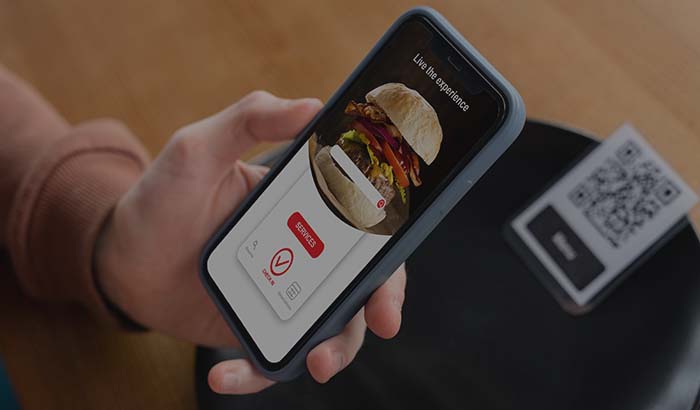
With RestApp your restaurant gets an ordering site running on your own domain and your own mobile app published on the App Store and Google Play. The customer sees your logo, your colors and your menu; there is no list of competing restaurants in between, no sponsored top slot and no 'similar restaurants' suggestion. There is one restaurant: you.
No commission is taken on any order from this channel. When a $20 order comes in, the marketplace leaves you $15 (after a 25% commission), while in your own channel the full $20 stays with you. In the Joe's Grill example above, moving even just a third of monthly orders to your own channel adds up to tens of thousands of dollars in commission savings every year.
Menu edits, photo updates, campaigns and price changes are all done from a single panel and apply instantly to both the site and the app. You set up your digital menu once, and delivery, pickup and dine-in orders all flow through the same menu. To try your own channel, you can start with a free trial.
Keep the customer data with you, not on the marketplace
The most invisible yet most expensive side of the marketplace model is data. You cannot see the phone number, email, full address or how often and what a customer ordered through Uber Eats. That customer belongs to the marketplace. When you want to reach them again, you are once more dependent on the marketplace and once more on commission.
In your own channel the situation reverses. The contact details, address and order history of every customer who places an order are kept in your own system. With that data you can build win-back actions such as 'a discount for a customer who has not ordered in the last 30 days', 'a special campaign on the most frequently ordered item' or a birthday offer.
The most powerful tool for retaining customers is a loyalty system. With loyalty and promotions features, a customer who collects points comes back on their next order directly to your channel rather than the marketplace. You can learn how to set up a loyalty program in how to build a restaurant loyalty program.
How do you move a marketplace customer to your own commission-free channel?
You do not need to leave the marketplace; the goal is to use it wisely. Once a customer who came through Uber Eats or another marketplace knocks on your door, you set up touchpoints that steer them to your own commission-free channel on their next order.
The most effective methods are simple and low cost: put a QR card on the delivery box that reads 'Next time, order commission-free directly from us, plus a welcome discount'; have that QR go straight to your QR e-menu and ordering page. Print your own site address at the bottom of the receipt. Set up the loyalty points you award on the first order so they can only be spent in your own channel.
In this approach the marketplace takes on the cost of acquiring a new customer once, and you protect your profit by moving that customer to your commission-free channel for life. You can find the detail of the logic in commission-free online ordering for restaurants; and with online payments the customer can safely pay by card in your own channel too.
Setup, pricing and how quickly do you go live?
Setting up your own channel does not turn into a technical project. You upload your menu and photos, connect your domain and payment method, and your app is published to the stores. Many restaurants go live with their own ordering site and QR menu in a short time; you start running in parallel without touching your marketplace listing at all.
On the cost side, the core difference is the model. On the marketplace you pay a percentage commission on every order, and the amount you pay grows as your order volume grows. In RestApp's own channel you pay a fixed plan fee with no commission; the more orders grow, the more profit stays with you. You can see current plans on the pricing page.
You do not need to make a big decision to get started. With a free trial, set up your own ordering site and QR menu, test it with a few orders and see the impact of a commission-free channel on your profit with your own numbers. Let the marketplace stay on as a storefront; you simply add the channel you own alongside it.
Uber Eats marketplace vs. your own RestApp channel
Marketplace (Uber Eats)
- • A commission of roughly 15-35% is cut per order
- • You are listed on the same page as competing restaurants
- • An extra advertising budget is needed to appear near the top
- • The customer's phone, address and data stay on the marketplace
- • You cannot reach the customer directly or run win-back actions
- • The commission you pay grows as order volume grows
Your own RestApp channel
- 0% commission on orders from your own channel; the full amount is yours
- Your own brand, your own site and mobile app; no competitors
- Dine-in QR e-menu, delivery and pickup in a single panel
- The customer data is yours; win-back through loyalty and campaigns
- A fixed plan fee, no percentage per order
- Runs alongside the marketplace, not instead of it, in parallel (not aggregation)
Key takeaways
- Uber Eats takes a commission per order just like other marketplaces; across food delivery marketplaces this rate typically falls in the rough range of 15% to 35%.
- At 40 orders a day, a $20 average ticket and a 25% commission, a restaurant can hand over around $72,000 a year to commission alone.
- RestApp is not aggregation: it does not pull or merge Uber Eats orders onto a single screen; it is a separate, commission-free channel that runs alongside the marketplace.
- Orders from your own branded site, iOS/Android app and QR menu carry no commission, and the customer data stays with you.
- The right strategy is to use the marketplace as a storefront for new customers and move regulars to your own commission-free channel with QR cards, receipt notes and loyalty points.
Frequently asked questions
How much commission does Uber Eats take from restaurants?+
The exact rate varies by region, category and the service provided. Across food delivery marketplaces, commission is generally somewhere between roughly 15% and 35% of the order total. The model is the same everywhere: a percentage is cut from every order, and the total commission you pay grows as your order volume grows.
Does RestApp aggregate my Uber Eats orders onto a single screen?+
No. RestApp is not an order aggregation tool; it does not pull or merge orders from Uber Eats or any other marketplace onto your screen. RestApp builds you a separate, commission-free ordering channel published under your own brand that runs in parallel alongside the marketplace. Your Uber Eats orders stay in the Uber Eats dashboard.
Do I have to leave the marketplace?+
No. The marketplace is a good storefront for reaching customers who do not know you yet, so keep it on. The recommended strategy is to use the marketplace for new customer visibility and move regulars to your own commission-free channel. The two run in parallel at the same time.
Is there really no commission at all in my own channel?+
Orders from your own RestApp channel (site, mobile app, QR menu) carry no commission; 100% of the order total stays with you. On the marketplace a $20 order leaves you $15 after a 25% commission, while in your own channel the full $20 stays with you. In this channel you pay a fixed plan fee, not a percentage per order.
How do I move a customer from the marketplace to my own channel?+
The most effective methods are low cost: put a QR card on the delivery box that links to your own ordering page, print your site address on the receipt, and set up the loyalty points you award on the first order so they can only be spent in your own channel. That way the marketplace takes on the cost of acquiring a new customer once, and you protect your profit by moving that customer to your commission-free channel.
Stop paying commission on your orders
Launch your own commission-free online ordering system with RestApp.