


June 13, 2026
Just Eat Commission and the Zero-Commission Alternative: Your Own Ordering Channel
Just Eat brings new customer visibility to your restaurant, but it takes a commission of somewhere between 15 and 35 percent on every order. On a $40 order, that means $6 to $14 goes to the marketplace. This article explains how to build your own branded ordering channel as a zero-commission alternative to Just Eat commission. There is a critical point here: the goal is not to leave the marketplace, it is to open a channel that belongs to you right next to it.
Let Just Eat stay on the storefront so new customers can discover you there. Move your repeat customers to your own commission-free online ordering channel. On every order that comes through your own website, your app, or your QR e-menu, 100 percent of the amount stays with you. RestApp is not something that replaces the marketplace here; it sets up a separate channel that is yours, at 0 percent commission.
If you want to see the topic in a wider frame, our article on marketplace versus your own ordering channel is a good starting point. In this guide, you will specifically see how restaurants using Just Eat can calculate their commission burden, how to set up their own channel, and how to draw customers to it through concrete steps. Just Eat is growing fast across many markets, which is exactly why building your own channel now is the strongest long-term move.
How does Just Eat commission erode your revenue?
Just Eat generally charges a commission of between 15 and 35 percent per order. The rate varies based on the restaurant's category, its agreement, and its participation in campaigns. Once delivery fees, service charges, and payment processing deductions are added on top, the bill grows even more. These line items do not show up on your menu price, but they come straight out of your profit margin.
Let's look at a concrete example. Maria's Kitchen, a mid-sized home-style restaurant, receives 600 orders a month from Just Eat with an average ticket of around $20. That is roughly $12,000 in monthly revenue. At a 25 percent commission, the restaurant pays about $3,000 a month and $36,000 a year to commission alone. That figure is equivalent to an employee's annual salary or the cost of opening a new location.
The truly painful part of the commission burden is that you pay the same rate for your most loyal customers. A customer who orders from you every week no longer needs the marketplace storefront; they already know you. But every time you accept that customer through Just Eat, you are paying a commission to introduce a customer you already know.
The zero-commission alternative to Just Eat: what does your own channel mean?
A zero-commission alternative does not mean abandoning the marketplace entirely. Your own channel is an ordering website live under your brand, your own mobile app on the App Store and Google Play, and a QR e-menu scanned at the table or on the delivery box. There is no commission to a middleman on orders from this channel; the full amount stays with you.
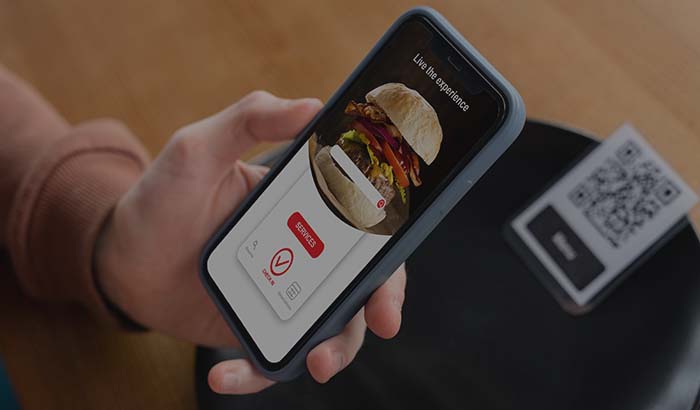
RestApp sets up exactly this channel. Your commission-free online ordering system runs on your own domain, connects to your kitchen and checkout flow through order tickets and cloud POS, and takes orders from the table or the package with a single QR code via your QR e-menu. The customer sees your brand, not a marketplace logo.
Here it is worth being honest: RestApp does not pull orders coming from Just Eat into your own screen or merge them onto a single screen. RestApp is a separate channel that runs alongside the marketplace. Just Eat stays as the storefront, while RestApp becomes the 0 percent commission sales door that belongs to you. To clarify the difference between the two channels, our article on marketplace commission versus your own website shows the same logic through different marketplaces.
Who keeps the customer data? The difference between the marketplace and your own channel
On an order that comes through Just Eat, the customer's phone number, address, and order history stay with the marketplace. You cannot reach that customer directly, you cannot send them a campaign, and you cannot win them back. The customer has effectively shopped from the marketplace, not from you; your restaurant is just one option.
On your own channel, the situation reverses. The customer data stays with you. Who orders how often, which product they prefer, who has not visited in a while; you see all of it. With this data you can use loyalty and promotion tools to call customers back with points, discounts, and special campaigns.
At the same time, on your own channel you are not listed side by side with your competitors. On the marketplace, when a customer opens your page they immediately see three similar restaurants right below and compare on price. On your own website and app, there is only your menu, your brand, and your offer. To see this difference in detail, you can look at our article on commission-free online ordering for restaurants.
How do you set up your own channel step by step?

The first step is to launch an ordering website and mobile app under your own brand. With RestApp you enter your menu, photos, and prices once; the website, app, and QR menu all feed from the same menu. When you update your digital menu, every channel updates instantly, with no price discrepancies or sold-out confusion.
The second step is payment and operations. With online payments the customer pays by card and the amount goes straight to you; there is no marketplace payment deduction. The order drops onto your order tickets and cloud POS screen, gets sent to the kitchen, and you manage the delivery process from there. To get set up, you can test the system with your real menu through try it free.
The third step is to see the pricing and make your decision. On the pricing page you see the channel cost as a fixed amount; as your orders grow, you do not face a compounding expense like percentage commission. In our example of 600 orders a month, paying a fixed channel cost instead of commission means keeping a large part of that $36,000 annual commission in your pocket.
How do you move marketplace customers to your own commission-free channel?
The strategy is simple: use the marketplace for new customer visibility, and pull that customer to your own channel on their second order. Put a small card with your own website's QR code inside every package that comes from Just Eat. Make the offer clear on the card: a treat is ready for you when you order from our own website next time.
Add your own website address to the receipt and the package label. The next time the customer searches, let them find you directly instead of having to go through the marketplace storefront. With a loyalty and promotion program set up on your own channel, a customer who earns points on every order gains a reason to come back. To build a loyalty setup from scratch, our article on how to set up a restaurant loyalty program guides you step by step.
Do this migration honestly: we are talking about introducing your own channel to your own customer, not a redirect that breaks marketplace rules. When a customer switches to your own website on their second or third order, 100 percent of those orders stay with you. The marketplace provides the first introduction; your own channel owns the relationship.
How do Just Eat and your own channel work together?
The right setup makes the two complements rather than rivals. Just Eat reaches the customer who does not know you yet; this visibility has a cost, and it makes sense to view that commission as new customer acquisition. Your own channel hosts the repeat customer who already knows you at 0 percent commission.
In practice, many restaurants run both channels in parallel. For how to set up your Just Eat integration and menu management, the Just Eat integration page becomes your reference point. At the same time you keep your own website live, taking new customers from the marketplace and steering repeat customers to your own channel.
This balance shifts the makeup of your revenue over time. At first most orders may come from the marketplace; as the months pass, loyal customers migrate to your own channel and your total commission burden drops. To deepen your understanding of the topic conceptually, our commission-free online ordering system guide brings the whole picture together.
The Just Eat storefront versus your own commission-free channel
Marketplace (Just Eat)
- • Commission of 15 to 35 percent per order
- • Customer phone, address, and data stay with the marketplace
- • You are listed side by side with competing restaurants on the same page
- • The customer remembers the marketplace's brand, not yours
- • No win-back or direct campaign capability
- • Strong storefront for new customer visibility
RestApp, your own channel
- 0 percent commission on orders from your own channel, 100 percent of the amount yours
- Customer data stays with you, you win them back through loyalty
- Only your menu and your brand appear on your own website
- Your own branded website, iOS and Android app, QR e-menu
- Fixed channel cost; expenses do not compound as orders grow
- Runs alongside the marketplace, does not replace it
Key takeaways
- Just Eat charges a commission of between 15 and 35 percent per order; a restaurant with 600 orders a month can pay tens of thousands of dollars a year to commission alone.
- RestApp does not replace the marketplace; it sets up a separate ordering channel that runs alongside it, under your own brand, at 0 percent commission.
- On your own channel the customer data stays with you, you are not listed side by side with your competitors, and 100 percent of the amount goes to you.
- The strategic path: use the marketplace for new customer visibility, and move repeat customers to your own channel with an in-package QR card, your website address on the receipt, and loyalty points.
- RestApp does not pull marketplace orders into your own screen or merge them; the two channels run in parallel, and your own channel becomes your commission-free sales door.
Frequently asked questions
How much is Just Eat commission?+
Just Eat commission generally ranges between 15 and 35 percent per order; the rate is set based on the restaurant's category, its agreement, and the campaigns it participates in. Delivery fees and payment deductions can be added on top, so the real cost ends up higher than the stated rate.
Does RestApp pull Just Eat orders into my own screen?+
No. RestApp does not pull, aggregate, or merge orders coming from Just Eat into your own POS or screen. RestApp is a separate channel that runs alongside the marketplace: it sets up a website, app, and QR e-menu under your own brand, and on orders from this own channel you pay 0 percent commission.
Do I have to leave Just Eat?+
No. The recommended strategy is to keep Just Eat as a storefront and open your own commission-free channel right next to it. The marketplace introduces you to new customers; you move repeat customers to your own website and app, freeing yourself from paying commission on those orders.
How do I draw marketplace customers to my own channel?+
Put a card with your own website's QR code in the package, write your website address on the receipt and label, and offer loyalty points on your own channel. When the customer switches to your own website on their second order, the full amount stays with you. This is simply introducing your own channel to your own customer.
Is the commission really zero on my own channel?+
On orders from your own website, app, or QR e-menu there is no middleman commission; 100 percent of the amount stays with you. On the RestApp side, instead of a percentage commission there is a fixed channel cost you can see on the pricing page, which means your expense does not compound as your orders grow.
Stop paying commission on your orders
Launch your own commission-free online ordering system with RestApp.