
May 7, 2026
Online Ordering and POS for Cafes: A Commission-Free Growth Guide
It is 8:30 in the morning, there is a line at the counter, and the barista has one hand on the espresso lever and the other on a delivery order coming in by phone. This is the reality of running a cafe: during peak hours every second turns into revenue, but in those same seconds orders get mixed up, customers wait, and the line keeps growing. Add the 15 to 35 percent commission that delivery marketplaces charge on top of every order, and the profit left per cup melts away. Even if a flat white sells for a healthy ticket, what stays in your pocket after the marketplace cut and packaging is often little more than spare change.
This article was written to solve exactly that. Building a commission-free online ordering channel for your cafe, taking fast table orders with a QR e-menu, and bringing your cloud POS and order ticket system together on one screen brings back both speed and profit. While the marketplace takes a commission on every customer, every order that comes through your own site and app lands in your register at 0 percent commission.
RestApp brings all of these channels together on a single platform for cafes. The online ordering solution for coffee shops connects every piece, from your own branded ordering site and mobile app to the kitchen screen and the loyalty program. Below we go through the real problems your cafe faces one by one, with a concrete solution for each.
The Line Never Clears at Peak Hours: A Faster Ordering Flow
The most critical 90 minutes for a cafe sit between the morning coffee rush and lunch. In that window every minute means 8 to 12 customers, and the moment the line passes three people, the fourth customer turns around before even stepping inside. The loss is not just that day's revenue; it is a regular who does not come back. The real bottleneck here is slow payment and order entry.
RestApp's cloud-based order ticket and POS system steps in right here. The barista opens an order in seconds from a tablet or phone, payment closes with a single tap, and the receipt is logged automatically. With a separate order-taking app, staff do not have to stay tied to the register; they can take orders from customers waiting in line ahead of time, so when the customer reaches the counter they only complete the payment. Line speed climbs noticeably.
As an example, a small specialty cafe cut its average morning wait time from 4 minutes to 90 seconds. The number of coffees served in the same shift rose by roughly 22 percent because no customer dropped off the line. Since the system runs in the cloud, even if the internet drops for a moment, order tickets are kept locally and sync once the connection returns.
The Menu Keeps Changing: Real-Time Control with a QR E-Menu
In cafes the menu is a living thing. Seasonal coffees come and go, the bean changes, the pastry case looks different every day, and when an item runs out it still sits on the menu, leaving you to apologize when a customer orders it. A printed menu means a trip back to the printer with every change, costing both money and time.
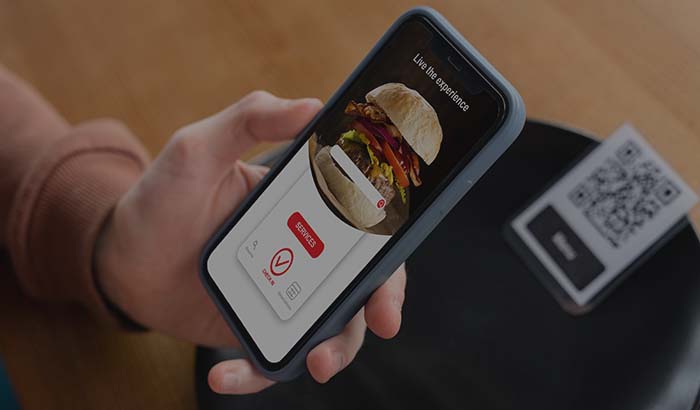
A QR e-menu solves this at the root. A customer who scans the QR code at the table always sees the current menu, current prices, and items actually in stock. You take a sold-out item offline with one tap and put a seasonal latte live in minutes. Because a digital menu is visual, described, and organized into categories, the average ticket also rises. When a customer sees a pastry with its photo, the chance of an extra order goes up.
You can use the QR menu not only for viewing but also for dine-in ordering. The customer places the order from their own phone at the table, the order goes straight to the barista, and the need to flag down a server disappears. During a busy patio service you reach more tables without adding staff. We explained what a QR menu is and how to set one up in detail in our QR menu guide.
Commission Eats Your Profit: Your Own Commission-Free Ordering Channel
The most insidious expense for cafes is marketplace commission. Delivery platforms take a cut of 15 to 35 percent per order. On low-margin products like filter coffee, that rate often wipes out the entire profit. On top of that, the customer is not yours but the platform's; you neither know their name nor can reach them again.

RestApp builds you a 0 percent commission channel that runs under your own brand. With commission-free online ordering you get your own ordering site and mobile app, the customer orders directly from you, and the commission in between disappears. With the online payment infrastructure, collection closes instantly, and by defining delivery zones you decide which neighborhoods you serve.
Let us put a concrete comparison on the table. Picture a cafe with 600 delivery orders a month and an average ticket of around $9. On the marketplace at a 25 percent commission, it hands roughly $1,350 a month to the platform. When that same volume shifts to its own commission-free channel, that money stays in its pocket, a difference of close to $16,000 a year. We laid out the math between the marketplace and your own site with real numbers in our marketplace commission versus your own site comparison.
Regulars Are Not Coming Back: Loyalty and Promotions
The lifeblood of the cafe business is the regular. A steady customer who drinks two coffees a day is worth more over a year than ten one-time customers. But a customer who comes through the marketplace forms no bond with you, and without your own channel you cannot tell who came how many times or what they ordered. Loyalty is left to chance.
RestApp's loyalty and promotions module connects the regular to the system. You define the rules yourself: the tenth coffee free, a birthday discount, a happy hour campaign at certain hours. The customer sees their points in your own app and has a reason to come back. This direct relationship, impossible on a marketplace, becomes standard in your own channel.
You also track whether the campaigns actually work through cloud reports. Which time slot is busier, which product sells more, whether the loyalty campaign increased repeat visits, all on one screen. It is also possible to run every branch of a cafe chain from one center with the cloud back office; you change the menu and price centrally and push it to all branches instantly.
Kitchen and Bar Get Tangled: One Screen for the Order Flow
In a cafe an order can go to three different places: the bar makes the coffee, the kitchen makes the toastie, the pastry case works separately. An order passed verbally gets mixed up at peak hours, a coffee is forgotten, a plate goes to the wrong table. These losses mean both wasted ingredients and lost customer satisfaction.
The kitchen display system (KDS) brings the order flow into order. Every order from the table, delivery, or pickup channel drops automatically to the right station; coffee to the bar, toastie to the kitchen. A finished item is marked on the screen and the serving order becomes transparent. The era of paper tickets and shouting orders across the room is over. We detailed how a KDS works in our kitchen display system guide.
Because all channels connect to a single order ticket system, the dine-in table, the delivery order, and the pickup customer are managed in the same flow. Pickup is an especially strong channel for cafes: the customer places the order through the app and grabs their coffee ready, without waiting in line, while you generate revenue without opening an extra table. All the different order types come together on one panel.
Costs Are a Mystery: Recipe, Inventory, and Order Ticket Control
Most cafe owners do not know the true cost of a cappuccino. Once you add up the beans, milk, syrup, cup, lid, and waste, the cost per cup comes out higher than expected. When inventory is tracked in a notebook, it stays unclear when which ingredient will run out, so you either end up with surplus stock or run out of milk at the busiest hour.
RestApp ties recipe and cost management to the order ticket system. When you define each product's recipe, every coffee sold is deducted from inventory automatically, and the real cost and profit margin become clear. As you see how much you earn on each product, you also price the menu more soundly. We explained how recipe and cost management saves a business in our recipe and cost management article.
The order ticket system itself is the foundation of the operation. Managing open tables, requests to split the bill, comps, and discounts from one place is what saves the day in a cafe. If you are wondering what an order ticket is and how to choose the right POS, our what is an order ticket guide and restaurant order ticket and POS system guide are two good places to start. If you would like to try it all for free, you can start a free trial right away.
Key takeaways
- Your own commission-free online ordering channel keeps the 15 to 35 percent commission that goes to the marketplace in your register, and it can create a difference of tens of thousands a year.
- A QR e-menu shows current prices and stock in real time, zeroes out the cost of a printed menu, and takes fast orders at the table.
- Cloud order ticket and POS increase line speed at peak hours and cut payment and order entry down to seconds.
- The loyalty and promotions module connects the regular to the system and builds the direct customer relationship that is impossible on a marketplace.
- Recipe and inventory control reveal the true cost of every coffee and make pricing and profit clear.
Frequently asked questions
How long does it take to set up an online ordering system for my cafe?+
Your own branded ordering site and menu can usually go live within a few days using ready-made templates. Once you define the menu, categories, and delivery zones, the QR menu and order ticket system come online from the same panel. You can test the process yourself with a free trial.
Can I really get out of marketplace commissions?+
Orders that come through your own ordering site and app carry 0 percent commission. You do not have to drop the marketplace entirely; most cafes use both channels together but steer their regulars to their own commission-free channel, gradually cutting the commission burden significantly.
Can customers order from the table with a QR menu?+
Yes. You can use the QR menu not only for viewing but also for dine-in ordering. The customer places the order from their own phone, the order goes straight to the bar or kitchen, and the time spent flagging down a server and taking the order disappears.
Does the cloud order ticket system work when the internet drops?+
Order tickets are also kept locally on the device. Even if the internet drops for a moment, you can keep taking orders, and when the connection returns all the data syncs to the cloud automatically. You do not lose sales to an outage during peak hours.
I have more than one branch; can I manage them all from one place?+
Yes. With the cloud back office you manage the menu, prices, and campaigns of all branches from one center and push changes to all branches instantly. Through cloud reports you can see the sales and performance of each branch separately or all together.
Stop paying commission on your orders
Launch your own commission-free online ordering system with RestApp.